


Effects of inter-row cover crop termination strategy on grapevine performance and mycorrhizal activity under contrasting seasonal conditions
In a 2026 study published in Field Crops Research based on Mediterranean rainfed vineyards, the authors found that roller-crimping cover crops improved soil cover, vine water status, yield (in wetter conditions), and mycorrhizal colonization without affecting grape quality, while seasonal climate was the dominant driver of fungal diversity.
Headline Findings:
- Roller-crimping cover crops (instead of tillage/green manuring) improved soil cover, vine water status, and mycorrhizal root colonization.
- In the wetter season, it also increased vine vigor and grape yield.
- Grape quality was not significantly affected by termination method.
- Seasonal climate had a stronger effect on mycorrhizal diversity than management strategy.
- Overall, roller-crimping appears to be a promising low-tillage vineyard management practice, especially under favorable moisture conditions.
Methods:
- Field experiment in a Mediterranean rainfed vineyard with inter-row cover crops.
- Compared two cover crop termination strategies:
- Roller-crimping (mechanically flattening cover crops as mulch)
- Conventional termination (tillage/green manuring approach, depending on treatment design)
- Conducted over two contrasting seasons (one wetter, one drier) to assess climate interaction effects.
- Measured:
- Vine performance (water status, canopy growth, pruning weight, yield)
- Grape composition (must quality parameters)
- Soil cover and moisture-related indicators
- Arbuscular mycorrhizal fungi (AMF):
- root colonization rates
- community diversity (molecular/sequence-based analysis of root-associated fungi)
- Design included replicated vineyard plots with statistical comparison between treatments and seasons.
Results:
- Water status: Roller-crimped cover crops improved vine water status, especially under drier conditions.
- Vine growth & yield: Higher canopy vigor, pruning weight, and yield in roller-crimped plots (notably in the wetter year).
- Soil effects: Greater soil surface cover and reduced bare soil with roller-crimping, improving moisture conservation.
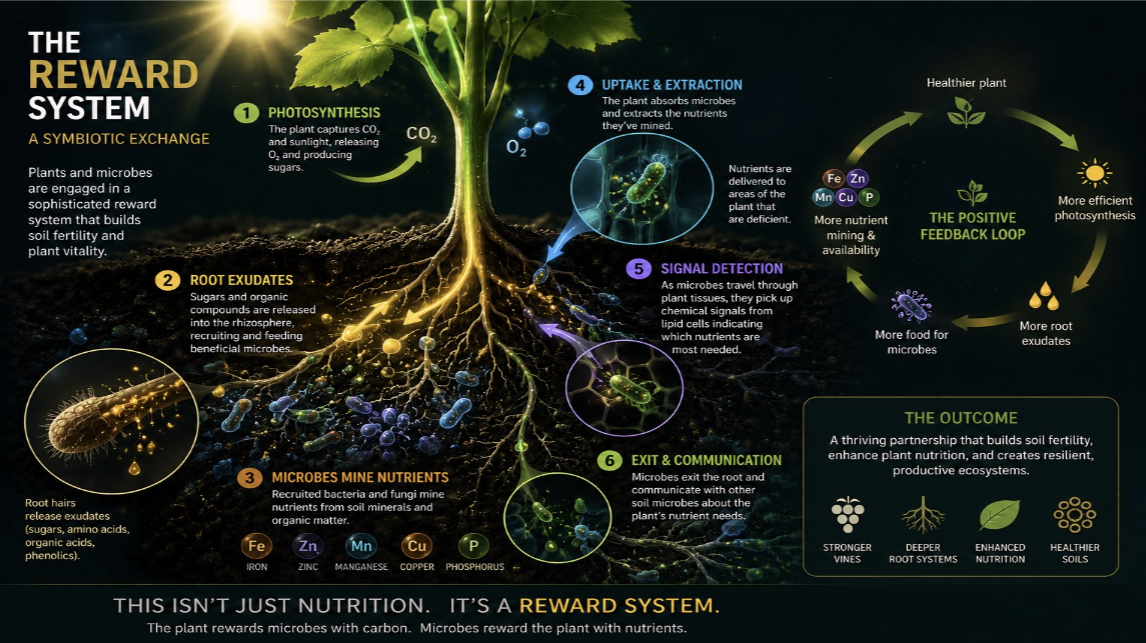
- Mycorrhizal activity:
- Higher arbuscular mycorrhizal fungi (AMF) root colonization in roller-crimped treatments, particularly in dry conditions.
- AMF diversity was mainly driven by seasonal climate rather than termination strategy.
- Grape composition: No significant differences in must/juice quality between treatments.
- Interaction effect: Benefits of roller-crimping were more pronounced in the wetter season; differences narrowed under drought stress.
Read the original study here.