



Rhizophagy – how plants farm soil microbes
Science continues to reveal just how sophisticated the relationship is between plant roots and the soil microbiome. We’ve written before about plants acting as miniature solar panels, using photosynthesis to produce sugars that are released into the soil as root exudates. These exudates feed soil microbes, creating a symbiotic partnership between plants and the organisms that live around their roots.
One of the most exciting developments in this field is the discovery of the rhizophagy cycle.
The concept was first described by researchers at the University of Queensland before being developed further by Dr James White and colleagues at Rutgers University. Dr White has also played a major role in communicating the science through interviews and educational resources, helping growers understand why the soil microbiome is so important to plant health.
There are some excellent video interviews on Youtube. This interview with Dr James White is particularly accessible.
RVF Director Becky Sykes interviewed Jordan Lonborg on this topic for a Wine Society webinar and Jordi is completely engaging on the subject of rhizophagy from about 30 minutes in.
Calling in the microbes
The rhizophagy cycle begins at the growing root tip.
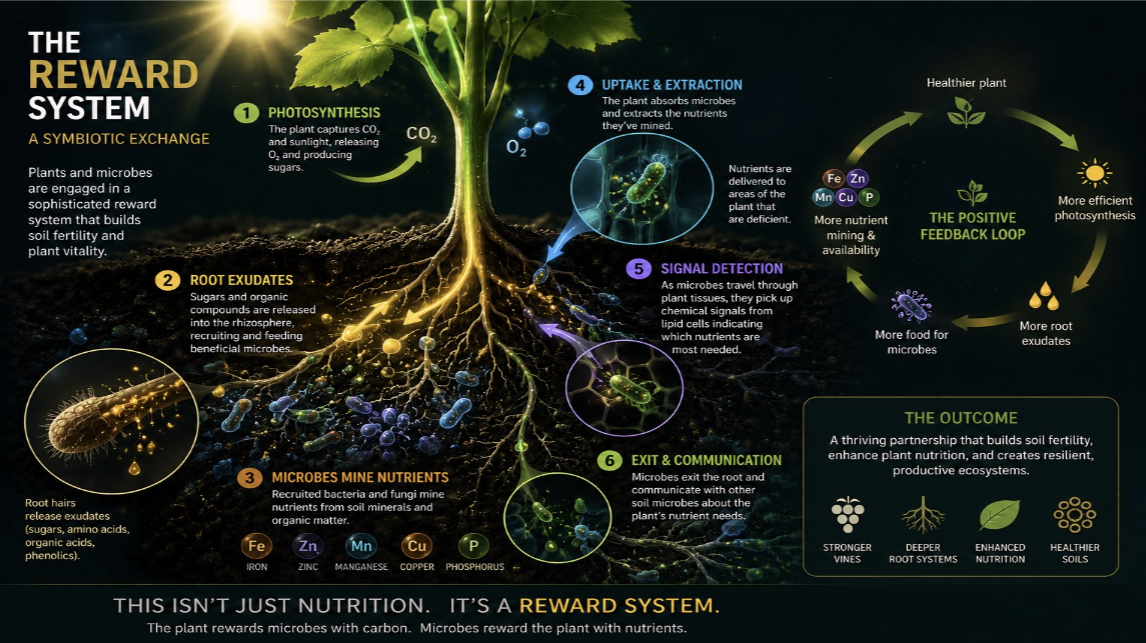
Plants release sugars, organic acids and other compounds as root exudates. These exudates act as an attractant, drawing bacteria and other microbes towards the root. Many bacteria are able to swim through thin films of water in the soil, following this stream of nutrients until they reach the root tip.
Researchers are still investigating exactly how the microbes enter the plant. The attraction may simply be due to the concentration of nutrients released by the root, although differences in electrical charge between the microbes and the root tip may also play a role. At present, this has not been studied sufficiently to know for certain.
The original Australian researchers proposed that the microbes enter through endocytosis, where the plant cell engulfs them. Another possibility is that they enter through tiny troughs between young cells. What is clear is that entry only occurs in the young, soft tissues around the meristem and elongation zone. As root cells mature, their walls harden and microbes can no longer pass through them.
Inside the plant
Once inside the root cells, the microbes do not damage the plant. Instead, the plant controls the process.
The plant produces reactive oxygen, which oxidises the microbial cell walls and strips them away, leaving living protoplasts (cells without cell walls).
Many minerals are attached to, or incorporated within, microbial cell walls and proteins. By processing the microbes in this way, the plant gains access to nutrients that would otherwise be difficult to obtain directly from the soil.
As Dr White describes it, the plant is effectively farming microbes to acquire nutrients.
More than plant nutrition
The rhizophagy cycle appears to do much more than simply deliver minerals.
The presence of microbes inside the root cells triggers the formation of root hairs, which are essential for nutrient uptake from the soil. Without microbes entering the root cells, root hairs do not develop normally.
The microbes also produce compounds that stimulate root hair elongation, leading to larger and more effective root systems.
According to this research, a healthy plant depends on acquiring microbes from the soil. Plants growing without these microbial partners are weaker and more susceptible to stress, while plants that successfully complete the rhizophagy cycle become better developed and more stress tolerant.
This helps explain a principle that regenerative agriculture has promoted for many years: healthy soils support healthier plants because healthy soils support diverse microbial communities.
Completing the cycle
The story does not end once the nutrients have been extracted.
Inside the plant, the microbial protoplasts move beneath the cell wall and eventually reach the growing root hairs. They produce hormones that encourage the root hairs to elongate.
As the root hair grows, the protoplasts are squeezed through tiny openings at the tip of the root hair and released back into the soil.
Outside the plant, they rebuild their cell walls and reform their flagella. Fresh root exudates provide the energy they need to recover before they once again acquire nutrients from the soil and are attracted back towards the root tip.
The cycle is complete:
Soil → root tip → inside the plant → root hair → back into the soil.
Seeing what had always been there
One reason the rhizophagy cycle remained undiscovered for so long was that the microbes were difficult to identify inside plant cells.
They could only be clearly seen using stains that detect reactive oxygen (the same chemistry the plant uses during the process). Researchers then confirmed their identity using protein tagging and other techniques.
Dr James White recalls the excitement of seeing the process for the first time.
“It was a eureka moment. It was the moment when I knew that we had something very exciting to share with the world. And from that time that Kate Kingsley and I were at the microscope and we had that realisation for the months and maybe years after that before we published, I felt like we had a secret. We had a secret and the world would at some point, when we got this published, would know about this secret. It was going to be earth shaking.
Looking back, he reflects that researchers simply hadn’t recognised what they were seeing.
“People should have seen it before, but the problem is once these microbes go into the plant cells you can’t see them unless you have reactive oxygen. We just don’t see what we don’t recognise as happening.”
Beyond nutrient supply
Researchers believe the benefits of the rhizophagy cycle extend well beyond mineral nutrition.
Plants that interact successfully with microbes appear to become more resilient to stresses such as heat, salinity and disease. They also produce higher levels of phenolics and other antioxidant compounds, which may help them manage the reactive oxygen involved in the process.
The interactions between plants and endophytic microbes may even influence gene expression. Researchers have observed microbes moving around the plant nucleus, raising intriguing questions about how microbes might influence plant development and adaptation. Much remains to be understood.
What does this mean for viticulture?
If vines depend on healthy microbial communities, then building soil biology becomes fundamental to grape production.
Practices such as cover cropping help build soil microbial populations, while there is a developing area of microbial biostimulants aimed at introducing or encouraging beneficial organisms around plant roots.
Researchers have also demonstrated that beneficial microbes can alter the behaviour of soil pathogens. In some cases, pathogenic fungi stop behaving as pathogens in the presence of the right microbial community, offering new opportunities to protect crops biologically.
According to Dr White’s work, biology has the potential to reduce dependence on fertilisers and fungicides by allowing plants to make fuller use of the natural processes that have evolved between roots and microbes.
The Future
The rhizophagy cycle is changing the way we think about plant nutrition.
Rather than simply absorbing minerals from the soil solution, plants actively recruit microbes, process them inside their own cells and release them back into the soil to gather more nutrients.
Many details still need to be worked out, but one message is already becoming clear: healthy soils rich in microbial life are fundamental to healthy, resilient plants.
Our understanding of the rhizophagy cycle is the most exciting development in plant nutrition. Researcher Dr James White: “It was a Eureka moment. It was the moment when I knew we had something very exciting to share with the world…. and it was going to be Earth shaking.”