


Five years of oxen grazing enhances soil carbon and structure in alpine vineyards
A study in Northern Italy by Fracasso Ilaria et al (2026) released in Scientific Reports provides evidence supporting the benefits of low-density cattle integration on vineyards.
Headline findings
- Higher soil carbon & nitrogen: ~14% increase in total organic carbon and ~12% increase in total nitrogen after five years of oxen grazing
- Improved soil structure: Greater micro-aggregate stability without increased soil bulk density (no evidence of compaction)
- Stable nutrients: No significant changes in available P, K, or other measured elements
- Microbial shift: Slight increase in bacterial abundance; fungal biomass unchanged
- No vine damage observed
Methods
- Five-year field comparison of oxen-grazed vs. ungrazed vineyard inter-rows
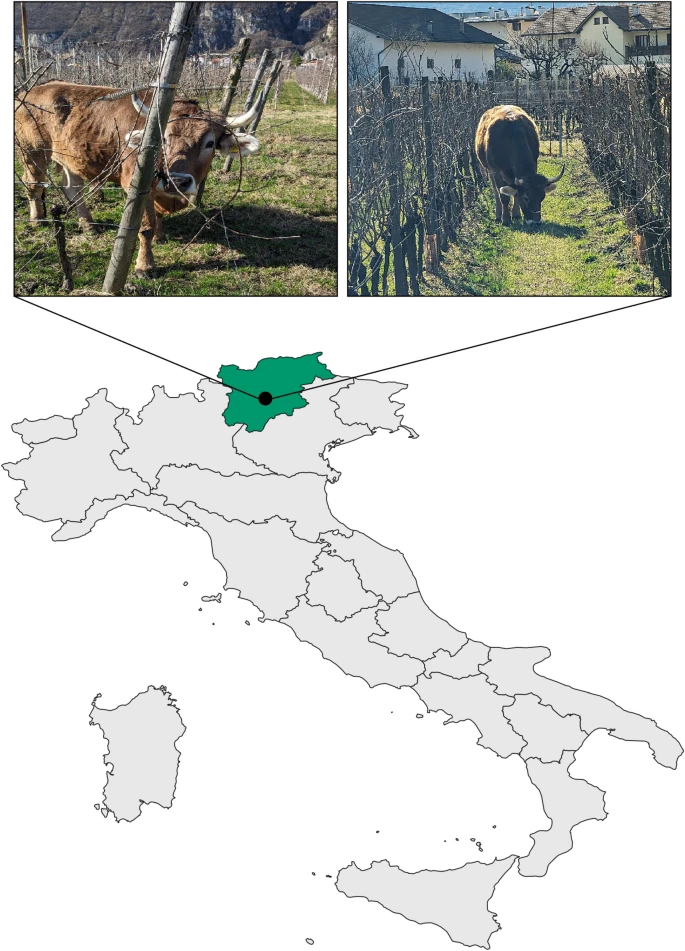
- Density of 5-7 oxen ha− 1
- Measured soil carbon, nitrogen, dissolved C, and nutrients
- Assessed bulk density and aggregate stability
- Quantified microbial biomass and bacterial/fungal abundance
- Statistical comparison of treatment effects over time
Results
- Soil organic carbon: ↑ ~14% in grazed plots
- Total nitrogen & dissolved carbon: ↑ ~11–12%
- Soil structure: Increase in fine water-stable aggregates (~14%)
- Soil compaction: No increase in bulk density
- Microbiology: Slight rise in bacterial abundance; fungi unchanged
Figure
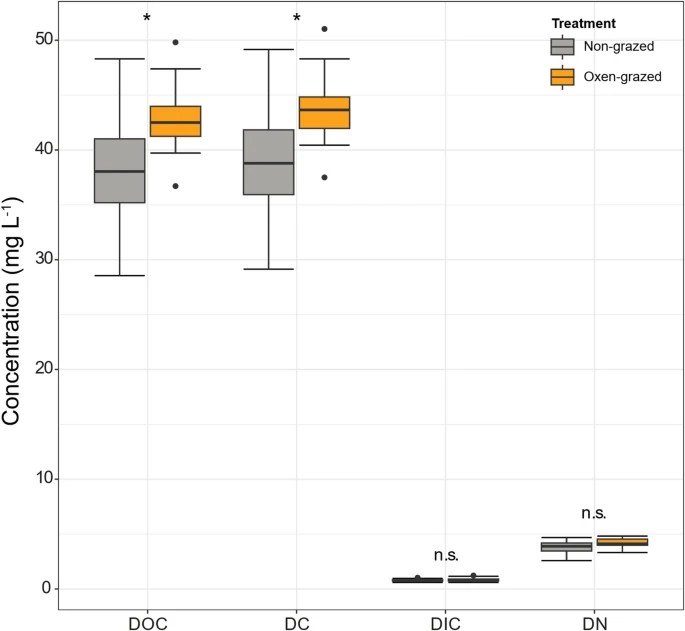
Dissolved Organic Carbon (DOC), Dissolved Carbon (DC), Dissolved Inorganic Carbon (DIC) and Dissolved Nitrogen (DN) content in mg L-1 in non-grazed and oxen-grazed sites (n = 15). Asterisks over to the boxes indicate statistically significant differences between treatments assessed by Student´s t-test (* = p < 0.05; ** = p < 0.01; *** = p < 0.001). If no significant difference was detected n.s. is displayed.
Overall conclusion
Moderate oxen grazing improved soil carbon and structure without causing compaction, supporting its use as a sustainable vineyard management strategy.
Moderate oxen grazing improved soil carbon and structure without causing compaction, supporting its use as a sustainable vineyard management strategy.