


On the subject of biochar
(French first, then English below)
By Antoine Lespès (alespes@domaine-lafage.com) and Alain Deloire (alain.deloire@supagro.fr)
28 decembre 2024
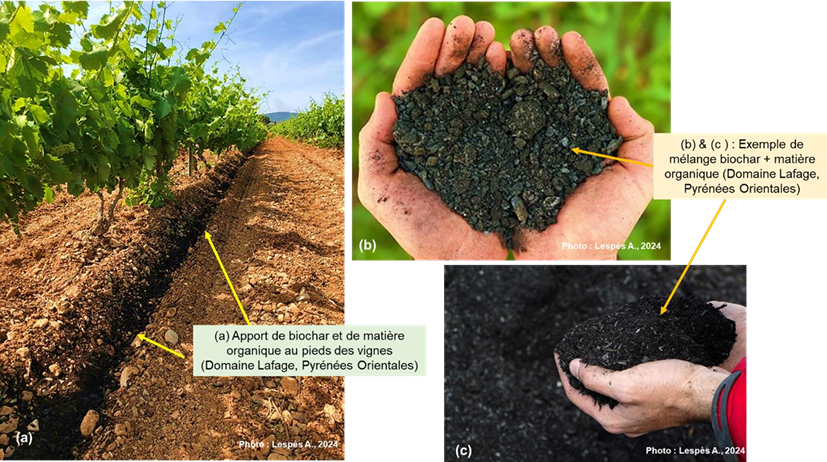
Figure 1 (FR) : Exemple d’épandage de biochar mélangé à de la matière organique le long du
rang de vignes. Le biochar est enfoui à environ 20 à 30 cm de profondeur à côté du rang.
Figure 1 (EN): Example of biochar mixed with organic matter applied along the vine rows. The
biochar is buried at a depth of approximately 20 to 30 cm next to the row.
Les populations précolombiennes de l’Amazonie produisaient du biochar en recouvrant la
biomasse en combustion de terre, formant ainsi un sol noir (terra preta de índio) qui peut être
utilisé pour augmenter la fertilité du sol.
Le biochar peut être défini comme « un matériau solide obtenu par la conversion
thermochimique de la biomasse dans un environnement à oxygène limité » (IBI, 2015).
Différentes méthodes de préparation peuvent être utilisées pour obtenir du biochar à partir
de diverses matières premières, telles que notamment la pyrogazeification (production de
Syngaz dont le biochar est un coproduit) et la pyrolyse pour la production de biochar avec
des températures moins élevées. Les biochars de Pyrolyse sont meilleurs pour les sols
agricoles : plus de stockage carbone et plus de porosité (figure 1). La pyrogazeification et la
pyrolyse, sont autosuffisantes en énergie.
Selon les caractéristiques des matières premières et des paramètres de pyrolyse (t°, taux de
monté en t° et temps de résidence), les propriétés physico-chimiques du biochar peuvent
varier considérablement. Le choix d’une matière première appropriée est essentiel si un
biochar doit être produit pour des applications environnementales spécifiques.
Les biochars résultants peuvent être utilisés dans une large gamme d’applications, y compris
l’amendement et la réhabilitation des sols, le traitement des eaux usées, le traitement des
gaz de combustion et l’atténuation du changement climatique.
Le bois, les résidus de cultures, l’herbe, les déchets animaux, les boues d’épuration et les
digestats anaérobies peuvent être utilisés. La filière biochar doit adopter une approche
circulaire et locale, en s’assurant que les biomasses utilisées ne soient pas en concurrence
avec d’autres industries (bois-énergie, compostage, méthanisation…).
Les biochars peuvent être des vecteurs efficaces pour les inoculants microbiens en raison de
leurs propriétés favorables à la vie microbienne. Les biochars peuvent également avoir un
impact positif sur la fertilité chimique du sol (CEC, pH) et fertilité physique du sol (porosité,
infiltration et rétention d’eau).
Les biochars sont enrichis en carbone organique, contiennent dans différentes proportions
de l’azote, du phosphore et du potassium en tant que nutriments, et possèdent une grande
porosité et une capacité de rétention d’humidité.
L’utilisation de biochars comme vecteurs d’inoculum microbien a montré que certains
favorisaient la persistance, la survie et la colonisation des microbes inoculés dans le sol et
les racines des plantes, jouant un rôle crucial dans les processus biochimiques du sol, le
cycle des nutriments et du carbone, et la réhabilitation des sols contaminés.
Ces résultats suggèrent que les biochars peuvent constituer un substitut prometteur aux
substrats non renouvelables, tels que la tourbe, pour formuler et délivrer des inoculants
microbiens.
Qu’en est-il pour la vigne ?
Il faut expérimenter, notamment l’association biochar + matière organique + irrigation de
précision en sol sec (cf les expérimentations Domaine LAFAGE et
https://techniloire.com/actualite/des-biochars-contre-le-stress-hydrique).
Baronti et al., 2022 confirment après 10 ans d’expérimentation au vignoble que le biochar en
association est une solution possible pour diminuer la contrainte hydrique de la vigne.
Toutefois les études doivent être menées au cas par cas.
About Biochar!
Pre-Columbian populations in the Amazon produced biochar by covering burning biomass
with soil, creating black soil (terra preta de índio) that can be used to enhance soil fertility.
Biochar can be defined as “a solid material obtained by the thermochemical conversion of
biomass in an oxygen-limited environment” (IBI, 2015).
Various preparation methods can be employed to produce biochar from diverse raw
materials, including:
- Pyrogasification: Producing syngas with biochar as a co-product.
- Pyrolysis: Producing biochar at lower temperatures, which is more suitable for
agricultural soils due to higher carbon storage and porosity (Figure 1).
Both pyrogasification and pyrolysis are energy self-sufficient. Depending on the
characteristics of the raw materials and pyrolysis parameters (temperature, heating rate, and
residence time), the physicochemical properties of biochar can vary significantly. Selecting
an appropriate raw material is critical if biochar is to be produced for specific environmental
applications.
The resulting biochars can be used in a wide range of applications, including:
- Soil amendment and rehabilitation
- Wastewater treatment
- Flue gas treatment
- Climate change mitigation
Potential feedstocks include wood, crop residues, grass, animal waste, sewage sludge, and
anaerobic digestates. The biochar sector should adopt a circular and localized approach,
ensuring that the biomass used does not compete with other industries (e.g., bioenergy,
composting, or anaerobic digestion).
Biochars can effectively serve as carriers for microbial inoculants due to their properties that
support microbial life. They can also have a positive impact on soil chemical fertility (e.g.,
cation exchange capacity, pH) and physical fertility (e.g., porosity, water infiltration, and
retention).
Biochars are rich in organic carbon, contain varying amounts of nitrogen, phosphorus, and
potassium as nutrients, and feature high porosity and moisture retention capacity.
Using biochars as carriers for microbial inoculants has demonstrated that they can enhance
the persistence, survival, and colonization of inoculated microbes in the soil and plant roots, playing a crucial role in soil biochemical processes, nutrient and carbon cycles, and the
rehabilitation of contaminated soils.
These findings suggest that biochars can be a promising substitute for non-renewable
substrates, such as peat, for formulating and delivering microbial inoculants.
What about grapevines?
Experiments are needed, particularly on the combination of biochar + organic matter +
precision irrigation in dry soils (see experiments at Domaine LAFAGE and Techniloire article
on biochar and water stress.
Baronti et al. (2022) confirmed after 10 years of vineyard experiments that biochar, in
combination with other practices, is a potential solution for reducing water stress in
grapevines. However, studies should be conducted on a case-by-case basis.
Bibliographic sources :
Azeem M. et al., 2023. Biochar-derived dissolved organic matter (BDOM) and its influence
on soil microbial community composition, function, and activity: A review, Critical Reviews in
Environmental Science and Technology, https://doi.org/10.1080/10643389.2023.2190333
Beatrice P. et al., 2024. The long-term effect of biochar application to Vitis vinifera L. reduces
fibrous and pioneer root production and increases their turnover rate in the upper soil layers,
Front. Plant Sci., Volume 15, https://doi.org/10.3389/fpls.2024.1384065
Bolan et al., 2023. The potential of biochar as a microbial carrier for agricultural and
environmental applications, http://dx.doi.org/10.1016/j.scitotenv.2023.163968
Baronti S., et al., 2022. Long term effect of biochar on soil plant water relation and fine roots :
results after 10 year of vineyard experiment, Science of Total Environment, 851,
http://dx.doi.org/10.1016/j.scitotenv.2022.158225
Brtnicky et al., 2021. A critical review of the possible adverse effects of biochar in the soil
environment, Science of the Total Environment, 796.
Nobile C. et al., 2022. Biochar and compost addition increases soil organic carbon content
and substitutes P and K fertilizer in three French cropping systems, Agronomy for
Sustainable Development 42:119, https://doi.org/10.1007/s13593-022-00848-7
Schmidt HP et al., 2021. Biochar in agriculture – A systematic review of 26 global meta
analyses, GCB Bioenergy, DOI: 10.1111/gcbb.12889